
Thursday, December 2, 2010
Katie Price Banned
Unfortunately just banned from driving. For 6 months. Apparently she was being pursued by photographers (what? surely the other way round?) After a string of driving offences she has 13 points on her license and even Mr Loophole couldn't persuade the judge to show clemency...

Wednesday, December 1, 2010
Cycle Superhighways - 'Pedal Power' Report
When the motorways were first built, they were not designed with single lanes, a 40MPH speed limit, roundabouts and frequent poor-quality junctions. That's because the vision was to provide a new, safe, fast means of travel that would accommodate increasing demand for some years into the future.
That's why the Cycle Superhighways are so disappointing. They sound like cycling's equivalent of a motorway. The reality is more like a badly-planned B-road.
The Transport Committee of the London Assembly have issued their report on the Mayor's headline cycling schemes: cycle hire and the CSHs. I'm going to concentrate on the CSH section of the report and pick out the juiciest, most flavoursome bits. Some of the material has been covered before in my report on the Transport Committee meeting here.
"The Committee’s review shows users of the cycle superhighways are experiencing various problems. In some places the blue cycle lanes are too narrow, occupied by other vehicles, disappear at busy junctions or are covered by parked vehicles...The Committee has found far less enthusiasm from new cyclists for the cycle superhighways. Many are concerned about safety and a lack of respect from other road users when using the cycle superhighways...There is a need to modify the approach to developing the future routes and to improve their features to ensure they are much safer and more attractive for new cyclists."
Yes, we know this already, and it was all so predictable. Leaving aside the tendency of some motorists to occasionally break the Highway Code, why would anyone expect motorists on some of the busiest roads in London to change their behaviour if they're not required to by law? Why shouldn't they park or stop where it's permitted? Why shouldn't they drive where it's legal to do so? In many places, all we have is blue paint with no legal status. While many motorists behave with consideration, it only takes a few selfish drivers to cause enough intimidation to make cycling very unpleasant.
"there are virtually no measures to reduce motor traffic volumes or speeds."
This point highlights exactly why the choice of route was so poor. By picking the A24, TfL set themselves a difficult problem, but I suspect it wasn't even a problem they had any intention of solving. For CSH7, I suggest TfL never intended, and still does not intend, to reduce traffic volumes. Therefore, it was set up to fail from the start. There's simply too much traffic on the A24.
Sustrans has highlighted that the greatest barrier to Londoners cycling, or cycling more, is fear of traffic yet the cycle superhighways generally follow busy arterial roads and provide no or minimal segregation from traffic. It therefore concludes that in their current form the cycle superhighways have limited scope to facilitate an uptake in cycling, particularly by new cyclists.
Exactly. Now it would be fair enough if the CSHs goal was simply to make existing cycle routes safer for existing cyclists, but it's failed even to do that. To spend £150M+ on measures that don't significantly increase total numbers of cyclists, and simply move the existing ones around a bit to a different route, is grossly profligate.
TfL has reported on lessons learned from the pilot cycle superhighways. These are largely about ensuring the features of the cycle superhighways are put in place more quickly. They include allowing more time to implement traffic orders to ensure more mandatory cycle lanes and considering suspension of parking and loading during peak hours on some parts of the routes.
Note the weasel words: "considering suspension of parking"; "some parts of the routes". They still don't get it. Any route is as good as its worst part. Without a firm commitment to minimum standards, the routes will fail to attract new cyclists. Now, TfL have some justification in complaining about the ridiculous bureaucracy involved in traffic orders. But their response, it appears, has been to silently given up. It could (and should) have complained loudly that traffic orders take too long to chase through the system, put the traffic orders in to remove parking spaces and implement parking/loading restrictions, and wait for them to get rubber-stamped. But instead, it's left the parking spaces there and put in advisory lanes. Does TfL have any follow-up plan to correct these problems? I suspect not, and to my knowledge they have not claimed otherwise.
[TfL said it] had to be pragmatic and practical. It needed to deliver the cycle superhighways in good time, at reasonable cost, whilst balancing the needs of all road users. It would never satisfy everybody.
Wait. 99% of London's roads have no cycle facilities worthy of the name. The Cycle Superhighways were supposed to be the "balance". They were specifically to satisfy cyclists, who are a group who are not satisfied anywhere else. But whenever TfL came to a tough decision on the CSHs, with one or two exceptions, they opted to maintain motor traffic priority and flow at the expense of cyclist priority and safety. That is not balance. Note that on many parts of CSH7 at peak times, the number of cycles approaches or even exceeds the number of motor vehicles. Given that a cycle is a much more efficient use of roadspace than a car, the logical "balance" would be to favour cycles. But for TfL, cycling is more of an irritation than a transport mode. The "real" transport mode is motor traffic, and its flow must be preserved at all costs. This would be defensible if all motor traffic were essential journeys that cannot reasonably be undertaken using another mode, but a lot of it is simply able-bodied people in private cars and taxis. And, of course, there would be fewer people taking their kids to school in cars or driving to work if there were safe cycle routes they could use.
The Committee would like to hear from the Mayor and TfL on any further steps that could be taken to develop the cycle superhighways. They should explore the scope to develop a ‘Bike Grid’ which could join together the cycle superhighways in central London by providing improved conditions for cyclists on some central London roads... TfL has reported that it has not linked the cycle superhighways in the centre because of the huge dispersal from the routes.
This "dispersal" idea is disingenuous. No road system takes the user direct from their starting point to their destination by the most direct line. The point is to provide a reasonable density of safe routes that take cyclists from the CSHs to each part of the central area. This is not an impossible task. Central London is full of minor roads that would be ideal for cycling if they weren't set up as one-way labyrinths and used as rat-runs by motor traffic. This is partly Westminster's fault of course, but rather than recognising the fact there is a great need for safe cycle routes in the central area, TfL seem to be in denial about it.
In any case, the "dispersal" notion is actually false in the case of CSH8. This ends at the Lambeth Bridge roundabout. The majority of users will be continuing on toward the West End and the City, through the nightmare gyratories of Parliament Square and Trafalgar Square. It's obvious that CSH8 should continue to Waterloo Bridge and beyond.
In summary, TfL take a lot of criticism from this report, and so they should. Bear in mind the Transport Committee are hardly a bunch of revolutionary zealots. Virtually from the word 'go', there have been attempts to lower expectations of the Superhighways, but even in relation to these unambitious goals they've failed to hit the mark. The Mayor has bet the farm (and £150M+ of public money) on the CSHs doing something 'revolutionary' for cycling, and the public have a right to expect results. So far, it's not looking good...
That's why the Cycle Superhighways are so disappointing. They sound like cycling's equivalent of a motorway. The reality is more like a badly-planned B-road.
The Transport Committee of the London Assembly have issued their report on the Mayor's headline cycling schemes: cycle hire and the CSHs. I'm going to concentrate on the CSH section of the report and pick out the juiciest, most flavoursome bits. Some of the material has been covered before in my report on the Transport Committee meeting here.
"The Committee’s review shows users of the cycle superhighways are experiencing various problems. In some places the blue cycle lanes are too narrow, occupied by other vehicles, disappear at busy junctions or are covered by parked vehicles...The Committee has found far less enthusiasm from new cyclists for the cycle superhighways. Many are concerned about safety and a lack of respect from other road users when using the cycle superhighways...There is a need to modify the approach to developing the future routes and to improve their features to ensure they are much safer and more attractive for new cyclists."
Yes, we know this already, and it was all so predictable. Leaving aside the tendency of some motorists to occasionally break the Highway Code, why would anyone expect motorists on some of the busiest roads in London to change their behaviour if they're not required to by law? Why shouldn't they park or stop where it's permitted? Why shouldn't they drive where it's legal to do so? In many places, all we have is blue paint with no legal status. While many motorists behave with consideration, it only takes a few selfish drivers to cause enough intimidation to make cycling very unpleasant.
"there are virtually no measures to reduce motor traffic volumes or speeds."
This point highlights exactly why the choice of route was so poor. By picking the A24, TfL set themselves a difficult problem, but I suspect it wasn't even a problem they had any intention of solving. For CSH7, I suggest TfL never intended, and still does not intend, to reduce traffic volumes. Therefore, it was set up to fail from the start. There's simply too much traffic on the A24.
Sustrans has highlighted that the greatest barrier to Londoners cycling, or cycling more, is fear of traffic yet the cycle superhighways generally follow busy arterial roads and provide no or minimal segregation from traffic. It therefore concludes that in their current form the cycle superhighways have limited scope to facilitate an uptake in cycling, particularly by new cyclists.
Exactly. Now it would be fair enough if the CSHs goal was simply to make existing cycle routes safer for existing cyclists, but it's failed even to do that. To spend £150M+ on measures that don't significantly increase total numbers of cyclists, and simply move the existing ones around a bit to a different route, is grossly profligate.
TfL has reported on lessons learned from the pilot cycle superhighways. These are largely about ensuring the features of the cycle superhighways are put in place more quickly. They include allowing more time to implement traffic orders to ensure more mandatory cycle lanes and considering suspension of parking and loading during peak hours on some parts of the routes.
Note the weasel words: "considering suspension of parking"; "some parts of the routes". They still don't get it. Any route is as good as its worst part. Without a firm commitment to minimum standards, the routes will fail to attract new cyclists. Now, TfL have some justification in complaining about the ridiculous bureaucracy involved in traffic orders. But their response, it appears, has been to silently given up. It could (and should) have complained loudly that traffic orders take too long to chase through the system, put the traffic orders in to remove parking spaces and implement parking/loading restrictions, and wait for them to get rubber-stamped. But instead, it's left the parking spaces there and put in advisory lanes. Does TfL have any follow-up plan to correct these problems? I suspect not, and to my knowledge they have not claimed otherwise.
[TfL said it] had to be pragmatic and practical. It needed to deliver the cycle superhighways in good time, at reasonable cost, whilst balancing the needs of all road users. It would never satisfy everybody.
Wait. 99% of London's roads have no cycle facilities worthy of the name. The Cycle Superhighways were supposed to be the "balance". They were specifically to satisfy cyclists, who are a group who are not satisfied anywhere else. But whenever TfL came to a tough decision on the CSHs, with one or two exceptions, they opted to maintain motor traffic priority and flow at the expense of cyclist priority and safety. That is not balance. Note that on many parts of CSH7 at peak times, the number of cycles approaches or even exceeds the number of motor vehicles. Given that a cycle is a much more efficient use of roadspace than a car, the logical "balance" would be to favour cycles. But for TfL, cycling is more of an irritation than a transport mode. The "real" transport mode is motor traffic, and its flow must be preserved at all costs. This would be defensible if all motor traffic were essential journeys that cannot reasonably be undertaken using another mode, but a lot of it is simply able-bodied people in private cars and taxis. And, of course, there would be fewer people taking their kids to school in cars or driving to work if there were safe cycle routes they could use.
The Committee would like to hear from the Mayor and TfL on any further steps that could be taken to develop the cycle superhighways. They should explore the scope to develop a ‘Bike Grid’ which could join together the cycle superhighways in central London by providing improved conditions for cyclists on some central London roads... TfL has reported that it has not linked the cycle superhighways in the centre because of the huge dispersal from the routes.
This "dispersal" idea is disingenuous. No road system takes the user direct from their starting point to their destination by the most direct line. The point is to provide a reasonable density of safe routes that take cyclists from the CSHs to each part of the central area. This is not an impossible task. Central London is full of minor roads that would be ideal for cycling if they weren't set up as one-way labyrinths and used as rat-runs by motor traffic. This is partly Westminster's fault of course, but rather than recognising the fact there is a great need for safe cycle routes in the central area, TfL seem to be in denial about it.
In any case, the "dispersal" notion is actually false in the case of CSH8. This ends at the Lambeth Bridge roundabout. The majority of users will be continuing on toward the West End and the City, through the nightmare gyratories of Parliament Square and Trafalgar Square. It's obvious that CSH8 should continue to Waterloo Bridge and beyond.
In summary, TfL take a lot of criticism from this report, and so they should. Bear in mind the Transport Committee are hardly a bunch of revolutionary zealots. Virtually from the word 'go', there have been attempts to lower expectations of the Superhighways, but even in relation to these unambitious goals they've failed to hit the mark. The Mayor has bet the farm (and £150M+ of public money) on the CSHs doing something 'revolutionary' for cycling, and the public have a right to expect results. So far, it's not looking good...
Tuesday, November 30, 2010
Cycle Not-so-Super Highways
Reported in the Standard, a survey for the London Assembly Transport Committee revealed that 60% of cyclists said they felt no safer on the superhighways than they did on ordinary roads.
Almost two thirds said the routes were not respected by motorists who regularly drove in them and parked in them
Just one per cent of cyclists said they started cycling specifically because of the superhighway scheme.
Hardly a ringing endorsement then, but all of this was totally predictable - and was widely predicted. Cyclists don't believe TfL's fairy story that you can just wave a blue paintbrush and magic away the danger. While there are some good people working at TfL who understand cycling, it's clear they don't have any significant influence, and the bad decisions to allow parking and even driving in the blue lanes, to not bother with junction treatments, to prioritize motor traffic at the expense of cycle safety, have show TfL to be an organization that cannot deliver cycling infrastructure. Cycling is not in TfL's DNA. It's time the Mayor set up a new organization with a direct reporting line and real clout to deliver the remaining superhighways, so that we don't waste taxpayers' on more of the same.
Almost two thirds said the routes were not respected by motorists who regularly drove in them and parked in them
Just one per cent of cyclists said they started cycling specifically because of the superhighway scheme.
Hardly a ringing endorsement then, but all of this was totally predictable - and was widely predicted. Cyclists don't believe TfL's fairy story that you can just wave a blue paintbrush and magic away the danger. While there are some good people working at TfL who understand cycling, it's clear they don't have any significant influence, and the bad decisions to allow parking and even driving in the blue lanes, to not bother with junction treatments, to prioritize motor traffic at the expense of cycle safety, have show TfL to be an organization that cannot deliver cycling infrastructure. Cycling is not in TfL's DNA. It's time the Mayor set up a new organization with a direct reporting line and real clout to deliver the remaining superhighways, so that we don't waste taxpayers' on more of the same.
New Wimbledon Railway Path
There have been some works on the railway path that runs on the north side of the main railway line from Wimbledon to Raynes Park.

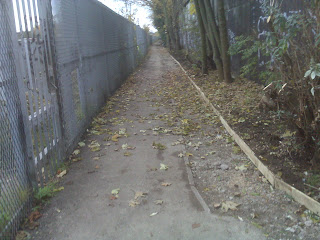
It appears that this path is being widened to form a cycle path. About time too! This has been planned for twenty years. When complete, it should be the best thing Merton has done for cycling in, well, 20 years. It should give cyclists a more-or-less traffic free route from Wimbledon to Raynes Park, and onwards to the A3 along the existing Coombe Lane segregated cycle path. There'll still be a couple of irritations:
1. It'll be necessary to cross Lower Downs Road. Here, it would be perfectly possible to install a cycle-priority crossing. Given that motor traffic is single-alternate-line here, a crossing wouldn't significantly impact on traffic flow.
2. Raynes Park itself is still very compromised from a cyclist's perspective, with a mess of shared pavement and the odd 'dismount' sign, but with the Railway Path in place there'll be more incentive for the Council to fix it properly (in the unlikely event of any spare cash being found).
3. There needs to be a proper link between the Wimbledon Chase cycle path and the Railway Path. Currently the choice is to go over one of the pedestrian bridges, which means hauling your bike up a flight of steps, or Lower Downs Road, which is a busy road with no cycle facilities.
4. There need to be links up the hill to Wimbledon Common.
But it's progress, the like of which we've not seen for many years. At this rate, by 2200, we might have a decent cycle network in Merton.


It appears that this path is being widened to form a cycle path. About time too! This has been planned for twenty years. When complete, it should be the best thing Merton has done for cycling in, well, 20 years. It should give cyclists a more-or-less traffic free route from Wimbledon to Raynes Park, and onwards to the A3 along the existing Coombe Lane segregated cycle path. There'll still be a couple of irritations:
1. It'll be necessary to cross Lower Downs Road. Here, it would be perfectly possible to install a cycle-priority crossing. Given that motor traffic is single-alternate-line here, a crossing wouldn't significantly impact on traffic flow.
2. Raynes Park itself is still very compromised from a cyclist's perspective, with a mess of shared pavement and the odd 'dismount' sign, but with the Railway Path in place there'll be more incentive for the Council to fix it properly (in the unlikely event of any spare cash being found).
3. There needs to be a proper link between the Wimbledon Chase cycle path and the Railway Path. Currently the choice is to go over one of the pedestrian bridges, which means hauling your bike up a flight of steps, or Lower Downs Road, which is a busy road with no cycle facilities.
4. There need to be links up the hill to Wimbledon Common.
But it's progress, the like of which we've not seen for many years. At this rate, by 2200, we might have a decent cycle network in Merton.
Public Health
The Coalition will be publishing its long-awaited Public Health White Paper later this week.
It's expected to continue the theme of localism: in other words, palming the responsibility off onto local government.
Dr Frank Atherton, president of the Association of Directors of Public Health, quoted on the BBC, said:
"It feels like we are coming home. Most public health directors are comfortable with being back in local government. This is where the power is to influence all those environment factors, such as housing, leisure and transport, lie and so the potential to really make a difference is definitely there."
The other trend expected to be in the White Paper is 'nudge': creating the right environment and encouraging people to make the right choices.
Getting people to make the right choices is the hard part however. Habits die hard. Large numbers of people, indeed large numbers of increasingly large people, continue to smoke and eat fatty foods despite previous public health campaigns. People don't want to stop eating chips or chocolate even though they know fine well the harm it's doing to them. But a lot of people do want to cycle. With cycling, the hard part of persuasion is already done: if you provide decent, safe cycle routes then people will cycle. In addition to the public health benefits, there's valuable contributions to reducing pollution and carbon emissions.
From a cycling perspective, it does make sense to have transport, the environment and public health under the same remit, as the benefits impact on all those spheres.
There are a couple of problems however. First is the lack of money. Without ring-fenced funds, will local authorities prioritize public health, and cycling in particular, above the local election 'hot buttons' of convenience of driving and parking, education and rubbish collection? Second, will they take the tough decisions that are necessary to establish a usable cycle route network? Third, an integrated cycle network has to cross borough boundaries. With boroughs like Westminster so anti-cycling, surrounding boroughs will be limited in what they can achieve.
Health Secretary Andrew Lansley is making some of the right noises. "We have got to arrive at a point where politicians stop just telling people how to be healthy but actually help them to do it, which is about positive steps on supporting people on things like physical activity as well as necessary interventions," he told the Today programme. However, cutting programmes such as cycling, school sports,and free swimming for children and the elderly are rather at odds with 'supporting physical activity.
We can't allow the Coalition to make noises about public health without actually delivering. Cycling is in many ways the easiest and cheapest way to get lots of people to increase their level of physical activity, because a lot of people want to do it and are only held back by fear of traffic. But it won't happen by magic and it won't happen without a change away from the failed approaches of the past. You can't grudging accommodate cyclists in narrow lanes in gravel-strewn gutters on busy roads and expect more people to cycle. You can't expect them to wobble around pedestrians on narrow shared pavements. You can't expect them to 'share the road' with multiple lanes of HGVs. You need to make cycling attractive and subjectively safe. You also can't expect local highways departments to change their lifelong habits of treating cyclists as an irritation rather than a transport mode, any more than you can expect a 20-stone smoker to suddenly become a triathlete. There are people in local government who 'get it', but the establishment for the most part is institutionally anti-cycling and car-centric, and without a serious culture makeover they won't be able to deliver. That's what the Public Health White Paper must to address if it is to succeed.
It's expected to continue the theme of localism: in other words, palming the responsibility off onto local government.
Dr Frank Atherton, president of the Association of Directors of Public Health, quoted on the BBC, said:
"It feels like we are coming home. Most public health directors are comfortable with being back in local government. This is where the power is to influence all those environment factors, such as housing, leisure and transport, lie and so the potential to really make a difference is definitely there."
The other trend expected to be in the White Paper is 'nudge': creating the right environment and encouraging people to make the right choices.
Getting people to make the right choices is the hard part however. Habits die hard. Large numbers of people, indeed large numbers of increasingly large people, continue to smoke and eat fatty foods despite previous public health campaigns. People don't want to stop eating chips or chocolate even though they know fine well the harm it's doing to them. But a lot of people do want to cycle. With cycling, the hard part of persuasion is already done: if you provide decent, safe cycle routes then people will cycle. In addition to the public health benefits, there's valuable contributions to reducing pollution and carbon emissions.
From a cycling perspective, it does make sense to have transport, the environment and public health under the same remit, as the benefits impact on all those spheres.
There are a couple of problems however. First is the lack of money. Without ring-fenced funds, will local authorities prioritize public health, and cycling in particular, above the local election 'hot buttons' of convenience of driving and parking, education and rubbish collection? Second, will they take the tough decisions that are necessary to establish a usable cycle route network? Third, an integrated cycle network has to cross borough boundaries. With boroughs like Westminster so anti-cycling, surrounding boroughs will be limited in what they can achieve.
Health Secretary Andrew Lansley is making some of the right noises. "We have got to arrive at a point where politicians stop just telling people how to be healthy but actually help them to do it, which is about positive steps on supporting people on things like physical activity as well as necessary interventions," he told the Today programme. However, cutting programmes such as cycling, school sports,and free swimming for children and the elderly are rather at odds with 'supporting physical activity.
We can't allow the Coalition to make noises about public health without actually delivering. Cycling is in many ways the easiest and cheapest way to get lots of people to increase their level of physical activity, because a lot of people want to do it and are only held back by fear of traffic. But it won't happen by magic and it won't happen without a change away from the failed approaches of the past. You can't grudging accommodate cyclists in narrow lanes in gravel-strewn gutters on busy roads and expect more people to cycle. You can't expect them to wobble around pedestrians on narrow shared pavements. You can't expect them to 'share the road' with multiple lanes of HGVs. You need to make cycling attractive and subjectively safe. You also can't expect local highways departments to change their lifelong habits of treating cyclists as an irritation rather than a transport mode, any more than you can expect a 20-stone smoker to suddenly become a triathlete. There are people in local government who 'get it', but the establishment for the most part is institutionally anti-cycling and car-centric, and without a serious culture makeover they won't be able to deliver. That's what the Public Health White Paper must to address if it is to succeed.
Monday, November 29, 2010
Government Car Service - Parking Fines
You'll remember back in the early, optimistic days of the Coalition, Cameron insisted that Government ministers should ditch their chauffeurred limos and use the tube instead, in order to rebuild trust in politicians following the expenses scandal. Six months on, the Indie reports that the Government Car Service has run up record parking fines, which DOUBLED compared to the same period in the previous year.
A Government Car and Despatch Agency (GCDA) spokesman said "security risks" were the reason for some of the tickets.
Maybe someone can explain how "security risks" have doubled in the space of a year. So much for rebuilding trust in politicians. (Funny how the GCDA didn't get abolished in the Bonfire of the Quangos).
A Government Car and Despatch Agency (GCDA) spokesman said "security risks" were the reason for some of the tickets.
Maybe someone can explain how "security risks" have doubled in the space of a year. So much for rebuilding trust in politicians. (Funny how the GCDA didn't get abolished in the Bonfire of the Quangos).
Air Quality
The Government has published a Command Paper containing their response to the Environmental Audit Committee's (EAC) 'Air Quality' report. You can read it here.
Let's have a quick taste of the choicest morsels:
Transport policy must change dramatically if the UK is to meet future targets and reduce exposure to air pollution.
Yes, that seems pretty obvious really, but what this report doesn't say is that the change to transport policy must reduce car and motor vehicle use dramatically. Otherwise people will die. Unfortunately the Government are more concerned with preserving people's freedom to drive how and where they like than the health problems of a few wheezing whingers, or the climate problems of our great-grandchildren.
The Government must explain the role played by brake, tyre and road wear in generating particulate matter and research the impact of road surface particulate matter on air quality.
It's well-known that brake, tyre and road wear contributes a very significant amount of particulate matter. However the Government's policy of encouraging speeding by removing speed cameras ensures this problem will get worse: the faster you drive, the faster your brakes and tyres wear.
We are looking at all options for how to further reduce air pollution from transport. For example, on the 28 July, the Secretary of State for Transport confirmed that motorists will receive up to £5,000 towards the purchase of an ultra-low emission car from January 2011. The grant will reduce the up-front cost of eligible vehicles by 25 per cent, capped at £5,000, and will be open to both private and business buyers.
This will help reduce NOx and diesel particulate emissions over the long term (although it won't reduce tyre/road wear), but it's extremely expensive and unlikely to have much effect in the short term.
Much can be done at a local level to change patterns of behaviour and encourage more sustainable travel, and the Department for Transport recently announced important changes to local transport funding which will allow local authorities to set their own priorities, and challenge them to find ways to facilitate sustainable transport modes.
Yes, except there's plenty of evidence that some local authorities don't understand sustainable transport, don't care about it and regard it as a political liability. There seems to be very little to stop local authorities spending 'sustainable' money on bypasses or simply maintaining existing programs, given the savage budget cuts they have to make.
.
We expect local authorities to bring forward packages of measures that could address a number of key challenges, including tackling local air quality problems.
Exactly my point. You 'expect', but you're not making them do anything.
At local level a number of locations have been exploring the effectiveness of ‘Smarter Choices’ measures on behaviour change. Darlington, Peterborough and Worcester recently trialled targeted promotion of sustainable ways to travel to reduce reliance on the car. Overall in the towns involved, car trips decreased by up to 9% with significant increases in walking, cycling and bus use.
And this is exactly the kind of thing that will happen less, as you're lumping all funding together in one 'sustainable' fund which councils can pretty much spend how they like. To reduce pollution and carbon emissions you need to reduce motor journeys. It really is that simple. Yet the Government have axed Cycling England, which instigated the Darlington Cycling Demonstration Town project. Air pollution is part of a wider public health problem, to which cycling is potentially a solution, or it would be if the Government promoted it.
The NHS Carbon Reduction Strategy (for England) recognises that improved air quality is a benefit both for patients and the wider population and that active travel, such as more walking and cycling, leads to reduced health risks and improving air quality.
Exactly my point. It's not rocket science, so why aren't you doing it?
Let's have a quick taste of the choicest morsels:
Transport policy must change dramatically if the UK is to meet future targets and reduce exposure to air pollution.
Yes, that seems pretty obvious really, but what this report doesn't say is that the change to transport policy must reduce car and motor vehicle use dramatically. Otherwise people will die. Unfortunately the Government are more concerned with preserving people's freedom to drive how and where they like than the health problems of a few wheezing whingers, or the climate problems of our great-grandchildren.
The Government must explain the role played by brake, tyre and road wear in generating particulate matter and research the impact of road surface particulate matter on air quality.
It's well-known that brake, tyre and road wear contributes a very significant amount of particulate matter. However the Government's policy of encouraging speeding by removing speed cameras ensures this problem will get worse: the faster you drive, the faster your brakes and tyres wear.
We are looking at all options for how to further reduce air pollution from transport. For example, on the 28 July, the Secretary of State for Transport confirmed that motorists will receive up to £5,000 towards the purchase of an ultra-low emission car from January 2011. The grant will reduce the up-front cost of eligible vehicles by 25 per cent, capped at £5,000, and will be open to both private and business buyers.
This will help reduce NOx and diesel particulate emissions over the long term (although it won't reduce tyre/road wear), but it's extremely expensive and unlikely to have much effect in the short term.
Much can be done at a local level to change patterns of behaviour and encourage more sustainable travel, and the Department for Transport recently announced important changes to local transport funding which will allow local authorities to set their own priorities, and challenge them to find ways to facilitate sustainable transport modes.
Yes, except there's plenty of evidence that some local authorities don't understand sustainable transport, don't care about it and regard it as a political liability. There seems to be very little to stop local authorities spending 'sustainable' money on bypasses or simply maintaining existing programs, given the savage budget cuts they have to make.
.
We expect local authorities to bring forward packages of measures that could address a number of key challenges, including tackling local air quality problems.
Exactly my point. You 'expect', but you're not making them do anything.
At local level a number of locations have been exploring the effectiveness of ‘Smarter Choices’ measures on behaviour change. Darlington, Peterborough and Worcester recently trialled targeted promotion of sustainable ways to travel to reduce reliance on the car. Overall in the towns involved, car trips decreased by up to 9% with significant increases in walking, cycling and bus use.
And this is exactly the kind of thing that will happen less, as you're lumping all funding together in one 'sustainable' fund which councils can pretty much spend how they like. To reduce pollution and carbon emissions you need to reduce motor journeys. It really is that simple. Yet the Government have axed Cycling England, which instigated the Darlington Cycling Demonstration Town project. Air pollution is part of a wider public health problem, to which cycling is potentially a solution, or it would be if the Government promoted it.
The NHS Carbon Reduction Strategy (for England) recognises that improved air quality is a benefit both for patients and the wider population and that active travel, such as more walking and cycling, leads to reduced health risks and improving air quality.
Exactly my point. It's not rocket science, so why aren't you doing it?
Subscribe to:
Posts (Atom)